AI, creator and digital execution paths now open — mentor-reviewed projects included.Explore paths →
Since 2012·2,276 learners trained·4.8★ Google rating·50+ hiring partners·National live learning • optional Pune support hub
Enterprise
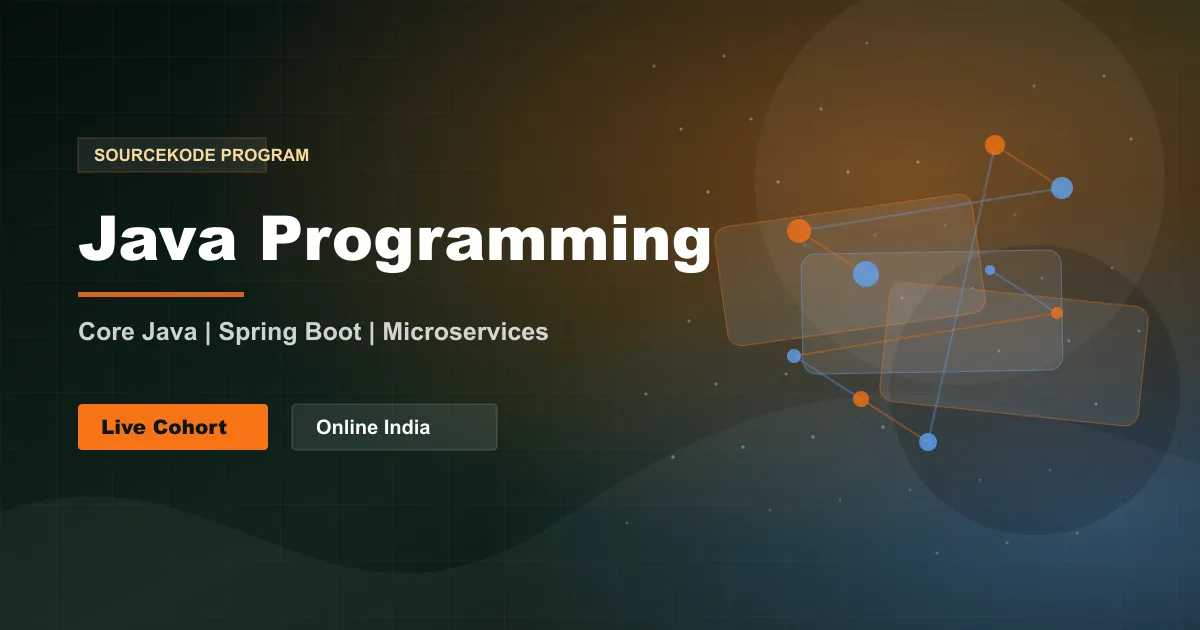
Java Full Stack Course — Build Real Apps with Spring Boot and APIs, Live
Learn Java, Spring, APIs and full stack foundations through practical builds designed for roles, products and portfolio proof.
See the full syllabus, fees and what you'll build before you pay a rupee. Live online classes with a personal mentor, small batches, and projects that go straight onto your portfolio.
See the structure, mentor support and next steps in one clear conversation.
Choose with human context, not a generic catalogue grid.A learning advisor helps you compare your goal, current level, time comfort and project expectations before you decide.
3 Monthsto structured project proof
25learner groups for feedback
4.8learner confidence score
Know what to build before you startGet feedback before your portfolio goes publicChoose the learning mode that fits your week
Next cohort starts 27 June 2026 · only 25 seats
Small groups of 25 learners so mentors can review work properly.
INR 15,000INR 25,00040% OFF
IncludedApplied Projects
IncludedCareer Context Included
IncludedPractitioner Mentors
IncludedContinued Learning Support
Free demo class before you pay · EMI options · 7-day money-back guarantee
Roadmap support is available from your first enquiry to live start.
Free roadmap check before you paySyllabus, pricing and live-start clarity in one callPortfolio proof you can explainMentor-reviewed project workLive online across India with optional Pune supportSmall groups for better feedbackFree roadmap check before you paySyllabus, pricing and live-start clarity in one callPortfolio proof you can explainMentor-reviewed project workLive online across India with optional Pune supportSmall groups for better feedback
Outcome-first learning path
Move from interest to useful Java Programming proof
SourceKode helps you decide whether this route is worth your time, then gives you a practical path to build, practise and show work with mentor feedback. The goal is not to collect another certificate. The goal is to become easier to trust, interview and hire.
Right fit
Know it suits you before you pay
Talk to a mentor first — we check whether Java Programming matches your background, time and goal, and tell you honestly if it doesn't.
Real projects
Build things you can show
Every module ends in a real project for your portfolio — the thing interviewers, clients and recruiters actually ask to see.
Live mentors
Never get stuck alone
Small live batches mean your doubts get answered in class, and your project work gets personal feedback before it goes public.
No surprises
Fees, dates and syllabus upfront
Exact fees with EMI options, the next batch date and the full syllabus — all before you commit a single rupee.
3 Monthsguided path to visible project proof
4+ enterprise projects you can discuss
25learners per group for better feedback
1 clearpricing, roadmap and syllabus plan before payment
Available across IndiaJoin Java Programming live online from anywhere in India, with optional Pune support if you prefer in-person help. Ask for the syllabus, pricing plan and live-start advice before you decide.
What does the Java Programming course cover?
The Java Programming path is a 3 Months, mentor-led program covering Java Programming, Applied Projects, Career Context Included, Practitioner Mentors — built around 4+ enterprise projects you can show in interviews.
Who is the Java Programming course for?
It suits beginner to advanced learners — students, working professionals and career switchers who want practical proof, not just a certificate. We check fit on a free roadmap call before you pay.
What are the fees and next batch for Java Programming?
Fees are INR 15,000 (from INR 25,000) with EMI options and a GST invoice. Live online in small batches of 25 — ask for the next start date and the full syllabus.
Course Overview
Master Java, the world’s most widely-used enterprise programming language powering billions of devices and applications. From Android apps to enterprise backends, cloud applications to big data systems, Java remains the backbone of modern software development.
Java learning path at SourceKode covers the complete Java ecosystem from Core Java fundamentals to enterprise frameworks like Spring Boot, Hibernate, and microservices architecture. Learn the technology trusted by Google, Amazon, Netflix, and 90% of Fortune 500 companies.
Why Learn Java?
Industry Standard: #1 language for enterprise applications for over 25 years
Highest Demand: Consistently top 3 in job postings worldwide
Platform Independent: “Write Once, Run Anywhere” - works on any device
Enterprise Focus: Preferred choice for banking, e-commerce, healthcare systems
Android Development: Official language for Android app development
High Salaries: Java developers command premium salaries (₹5-25 LPA)
Strong Ecosystem: Massive libraries, frameworks, tools, and community
Career Stability: Long-term demand guaranteed in enterprise sector
Upon successful completion of the course and projects, you will receive a Certificate of Completion from SourceKode, recognized by top IT companies and MNCs.
Career Opportunities
Java developers are in extremely high demand across all sectors:
Java Developer - Average: ₹4-12 LPA
Backend Developer - Average: ₹5-14 LPA
Full Stack Java Developer - Average: ₹6-16 LPA
Spring Boot Developer - Average: ₹6-15 LPA
Senior Java Architect - Average: ₹15-30 LPA
Android Developer - Average: ₹5-13 LPA
Companies Using Java
Tech Giants: Google, Amazon, Netflix, LinkedIn
Banking: HDFC Bank, ICICI, Axis Bank, all major banks
E-commerce: Flipkart, Amazon India, Myntra
IT Services: TCS, Infosys, Wipro, Cognizant, Accenture
Product: Oracle, Adobe, SAP, IBM
Startups: PhonePe, Swiggy, Zomato, Razorpay
Java Ecosystem Advantages
Spring Ecosystem: Comprehensive framework for any application type
Rich Libraries: Apache Commons, Guava, Lombok, and thousands more
Build Tools: Maven, Gradle for automated builds
Testing: JUnit, TestNG, Mockito for quality code
IDEs: IntelliJ IDEA, Eclipse with excellent support
Monitoring: Spring Actuator, Prometheus, Grafana
Prerequisites
Basic programming concepts
Computer fundamentals
No prior Java knowledge required
Database basics helpful but not mandatory
Career Support
Comprehensive career support including:
Resume Building with Java projects
Mock Technical Interviews (Core Java + Spring Boot)
Job Referrals to MNCs and product companies
GitHub portfolio setup
LinkedIn optimization for Java roles
Interview preparation covering:
OOP concepts
Collections framework
Multithreading
Spring Boot internals
Microservices architecture
System design basics
Salary negotiation guidance
Aptitude & coding test preparation
Why SourceKode for Java?
Complete Curriculum: Core to Advanced to Spring Boot
Hands-on Focus: More coding, less theory
Industry Projects: Real-world enterprise applications
Latest Versions: Java 17+, Spring Boot 3.x
Career Support Track Record: 800+ learners placed
Expert Trainers: 10+ years industry experience
Continued Learning Support: Continuous mentorship
Course Highlights
Build a complete e-commerce backend from scratch
Deploy Spring Boot applications to cloud
Create microservices with service discovery
Write production-quality unit and integration tests
Follow industry-standard coding practices
Learn design patterns and SOLID principles
Java Developer Salary in India (2026)
Experience
Typical Role
Salary Range (₹ / year)
Fresher (0–1 yr, with projects)
Junior Java Developer
₹3,50,000 – ₹7,00,000
2–4 years
Java / Spring Boot Developer
₹8,00,000 – ₹18,00,000
5–8 years
Senior Java Engineer
₹22,00,000 – ₹35,00,000
8+ years
Java Architect / Tech Lead
₹35,00,000 – ₹55,00,000+
Indicative ranges for India in 2026. Java remains a backbone of enterprise and banking systems, and Spring Boot + microservices skills lift pay the fastest. Pair Java with Android for mobile or AWS Cloud for backend deployment.
Meet your mentors
Real people teach this course — and review your work
KKarthik KumarSenior Software Architect
12+ years in production engineering; reviews learner projects personally.
RRahul DeshmukhFull Stack Developer & Trainer
Runs the hands-on build sessions and debugging labs.
PPriya SharmaSenior Tech Career Counsellor
Handles roadmap fit, interview preparation and career planning.
Will this fit you?
A fast roadmap snapshot for schedule, skill level and outcome fit.
3 Monthsguided pace
4+ Enterprise Projects portfolio proof
25learner cohort
LanguageEnglish, Hindi, Marathi
Duration3 Months
Lectures70+ Hours
Projects4+ Enterprise Projects
Skill levelBeginner to Advanced
CertificationYes
Max learners25
Plan your next step
Get pricing, start dates, project roadmap and mentor support explained before you commit.
A real advisor checks fit before you choose a learning path.
Delhi Bangalore Mumbai Hyderabad Chennai Pune Kolkata Noida Ahmedabad Jaipur Online
Learner Outcomes
Outcome Stories
V
"The Spring Boot and microservices modules were exactly what companies ask for in interviews. SourceKode's curriculum is truly industry-aligned."
Vikram Desai
Java Developer at Infosys
N
"As a non-CS graduate, Java seemed intimidating. SourceKode's step-by-step approach from Core Java to enterprise development gave me confidence and a job."
Neha Thorat
Backend Developer at Persistent Systems
2,276
Learners Trained
50+
Cities Across India
4.8/5
Google Rating
100%
Career Support
Hiring partners include TCS, Infosys, Wipro, Accenture, Capgemini, Zensar & 200+ more
Common Questions
Frequently Asked Questions
Is Java still relevant in 2026?
Absolutely! Java remains one of the most in-demand programming languages, powering Android apps, enterprise applications, banking systems, and big data technologies. Companies like Amazon, Google, and most banks heavily use Java.
Java vs Python - which should I learn first?
Java is better for understanding computer science fundamentals, OOP concepts, and building scalable applications. Python is easier to learn initially. For enterprise jobs and Android development, choose Java. For data science and quick prototyping, choose Python.
Do I need to learn C++ before Java?
No, Java can be learned independently. While C++ knowledge helps with understanding pointers and memory management, Java's simpler syntax and automatic garbage collection make it beginner-friendly without C++ background.
What is the difference between Core Java and Advanced Java?
Core Java covers fundamentals: syntax, OOP, collections, multithreading. Advanced Java focuses on enterprise technologies: Servlets, JSP, JDBC, Spring Framework, Hibernate, RESTful APIs. Both are essential for professional Java development.
Is Spring Boot difficult to learn?
Spring Boot simplifies Java development significantly. With solid Core Java knowledge, Spring Boot is manageable. Our course teaches Spring Boot practically with projects, making it easy to grasp. It's industry-standard for backend development.
Can I get a job with just Core Java knowledge?
For entry-level positions, Core Java with good problem-solving skills can get you started. However, learning Spring Boot, Hibernate, and REST APIs (Advanced Java) significantly improves job prospects and salaries in the ₹6-15 LPA range.
What jobs can I get after learning Java?
Java Developer, Backend Developer, Android Developer, Full Stack Developer, Spring Boot Developer, Microservices Engineer, or Enterprise Application Developer with salaries ranging from ₹4-30 LPA based on experience.
How long does it take to become job-ready in Java?
Our comprehensive 3-month course (70+ hours) covering Core Java, Spring Boot, Hibernate, and Microservices with applied projects makes you enterprise-ready. Focus on building a strong GitHub portfolio with deployed applications.
What is the Java developer salary in India in 2026?
Freshers with project proof typically start at ₹3.5–7 LPA. With 2–4 years of experience Java developers earn ₹8–18 LPA, and senior or architect-level engineers (Spring Boot, microservices) reach ₹22–40 LPA+. Java pay is especially strong in banking, finance and large enterprises.
Learning path check
Want to know if Java Programming is the right next step?
We will help you compare syllabus depth, project proof, pricing and live-start fit so you can decide with confidence.
Small groups for feedbackLive online across India; optional Pune supportEMI and roadmap support
Analytics is on by default. We use GA4, Clarity and marketing pixels to improve campaigns, leads and course recommendations. You can opt out anytime. Privacy Policy.